Date : 02 Jun 2026
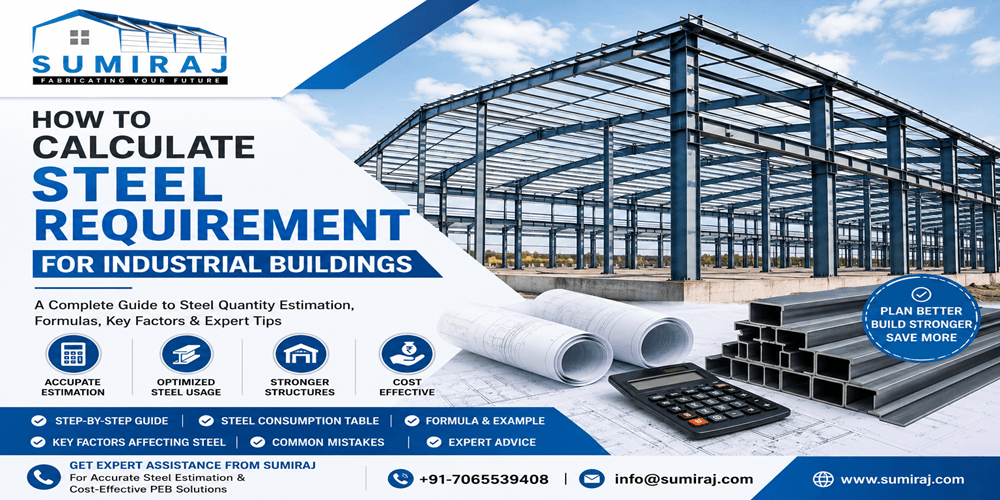
How to Calculate Steel Requirement for Industrial Buildings: A Complete Guide
How to Calculate Steel Requirement for Industrial Buildings: A Complete Guide
Introduction
Steel is the backbone of modern industrial construction. Whether you are planning a warehouse, factory, logistics center, workshop, or manufacturing plant, accurately calculating steel requirements is essential for budgeting, structural safety, and project planning.
At Sumiraj, we specialize in designing and manufacturing high-quality Pre-Engineered Buildings (PEB) that optimize steel usage while ensuring superior strength, durability, and cost efficiency. This guide explains the key factors involved in estimating steel requirements for industrial buildings.
Why Steel Requirement for Industrial Buildings Matters
Proper steel estimation helps:
-
Control project costs
-
Optimize structural design
-
Reduce material wastage
-
Improve project scheduling
-
Ensure structural safety and compliance
-
Streamline procurement and fabrication
Incorrect estimates can lead to budget overruns, project delays, and unnecessary material expenses.
Factors Affecting Steel Requirement for Industrial Buildings
Several factors influence the total steel consumption of an industrial building.
1. Building Dimensions
The overall length, width, and height significantly impact steel requirements.
For example:
-
A 30m × 60m warehouse requires less steel than a 50m × 100m facility.
-
Taller buildings generally require stronger columns and framing systems.
2. Building Purpose
Different industrial applications have different load requirements.
Examples include:
-
Manufacturing Plants
-
Warehouses
-
Cold Storage Facilities
-
Logistics Centers
-
Workshops
-
Distribution Hubs
Heavy industrial facilities typically require more steel compared to storage buildings.
3. Roof Design
Roof type directly affects steel consumption.
Common roof systems include:
-
Single Slope Roof
-
Gable Roof
-
Monitor Roof
-
Multi-Span Roof
Complex roof designs generally require additional structural members.
4. Crane Load Requirements
Industrial buildings equipped with EOT cranes require:
-
Crane Beams
-
Crane Brackets
-
Additional Column Reinforcement
This increases the overall steel tonnage.
5. Wind and Seismic Loads
Location-specific environmental factors also influence steel requirements, including:
-
Wind Speed
-
Seismic Zone
-
Snow Loads (where applicable)
Higher load requirements result in heavier structural members.
Typical Steel Consumption in Industrial Buildings
Although actual requirements vary based on project specifications, the following ranges are commonly observed:
| Building Type | Approximate Steel Consumption |
|---|---|
| Light Warehouse | 3 – 5 kg/sq.ft |
| Standard Industrial Shed | 4 – 7 kg/sq.ft |
| Manufacturing Plant | 6 – 10 kg/sq.ft |
| Heavy Industrial Facility | 8 – 15 kg/sq.ft |
These values should only be used for preliminary budgeting purposes. Detailed engineering calculations are required for accurate estimates.
Basic Formula for Estimating Steel Requirement
Steel requirement can be estimated using the following formula:
Steel Requirement = Building Area × Steel Consumption Rate
Example Calculation
Suppose:
-
Building Size = 100 ft × 200 ft
-
Total Area = 20,000 sq.ft
-
Estimated Steel Consumption = 5 kg/sq.ft
Calculation:
20,000 × 5 = 100,000 kg
Therefore:
Total Steel Requirement = 100 Metric Tons (MT)
This provides a preliminary estimate before detailed structural design and analysis.
Components Included in Steel Quantity Calculation
A complete industrial building steel estimate includes multiple structural components.
Primary Members
-
Columns
-
Rafters
-
Crane Beams
Secondary Members
-
Purlins
-
Girts
-
Eave Struts
Bracing Systems
-
Roof Bracing
-
Wall Bracing
-
Sag Rods
Connection Components
-
Base Plates
-
Anchor Bolts
-
Fasteners
-
Connection Plates
Miscellaneous Steel
-
Mezzanine Structures
-
Platforms
-
Staircases
-
Handrails
Ignoring these components can result in inaccurate steel estimation.
Why PEB Structures Use Less Steel
Pre-Engineered Buildings are designed using advanced structural engineering software that optimizes every steel member.
Benefits include:
-
Reduced Steel Consumption
-
Faster Construction
-
Lower Foundation Costs
-
Better Structural Efficiency
-
Reduced Project Cost
-
Improved Material Utilization
At Sumiraj, our engineering team carefully designs each structure to achieve maximum strength while minimizing steel consumption.
Common Mistakes in Steel Estimation
Avoid these common errors:
-
Ignoring crane loads
-
Underestimating wind loads
-
Excluding connection materials
-
Using generic consumption rates for all projects
-
Not considering future expansion requirements
-
Ignoring mezzanine or platform loads
Professional structural design is essential for obtaining accurate steel quantities.
Why Choose Sumiraj for Industrial Building and PEB Projects
At Sumiraj, we provide:
-
Customized PEB Design Solutions
-
Detailed Steel Quantity Analysis
-
Cost-Effective Structural Optimization
-
Industrial Shed Design & Manufacturing
-
Factory Building Solutions
-
Warehouse Construction Expertise
-
End-to-End Project Support
Our experienced engineering team ensures every project is designed for maximum efficiency, durability, and long-term value.
Frequently Asked Questions (FAQs)
How much steel is required for an industrial building?
Steel requirements typically range from 3–15 kg/sq.ft depending on building span, height, crane loads, roof design, and structural requirements.
How do I calculate steel requirement for a warehouse?
Multiply the total building area by the estimated steel consumption rate. However, for accurate calculations, professional structural analysis is recommended.
Do PEB buildings use less steel than conventional buildings?
Yes. PEB structures are engineered to optimize material usage, often resulting in lower steel consumption and reduced overall construction costs.
What factors increase steel consumption in industrial sheds?
Factors such as larger spans, crane systems, higher building heights, wind loads, seismic requirements, mezzanine floors, and future expansion provisions can increase steel consumption.
Conclusion
Calculating steel requirements for industrial buildings is a critical step in project planning and budgeting. While preliminary estimates can be made using standard steel consumption rates, accurate quantities require professional structural analysis based on building dimensions, load conditions, and project-specific requirements.
Choosing an experienced PEB manufacturer helps ensure optimized steel usage, reduced project costs, and long-term structural reliability.
Whether you are planning a warehouse, factory, logistics center, or industrial shed, obtaining an accurate steel estimate can significantly improve project efficiency and profitability.
Get Expert Assistance from Sumiraj
Planning an industrial building, warehouse, factory, or PEB shed?
Contact Sumiraj today for a customized steel requirement analysis and cost-effective PEB solution tailored to your project needs.
📞 Phone: +91-7065539408
📧 Email: info@sumiraj.com
Why Choose Sumiraj?
✅ Customized PEB Solutions
✅ Optimized Steel Consumption
✅ High-Quality Fabrication
✅ Fast Project Execution
✅ End-to-End Engineering Support
Sumiraj – Fabricating Your Future with High-Quality PEB Solutions Across India.